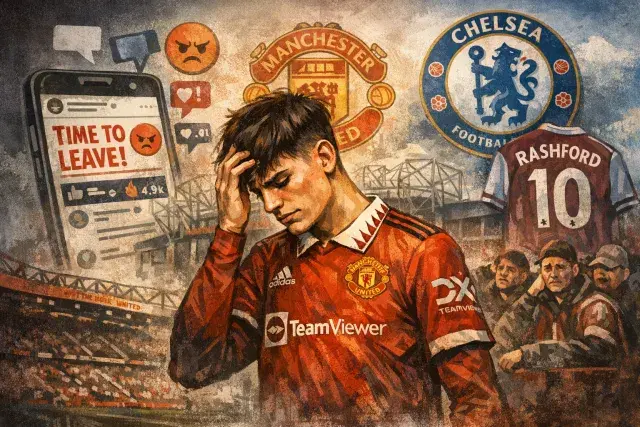
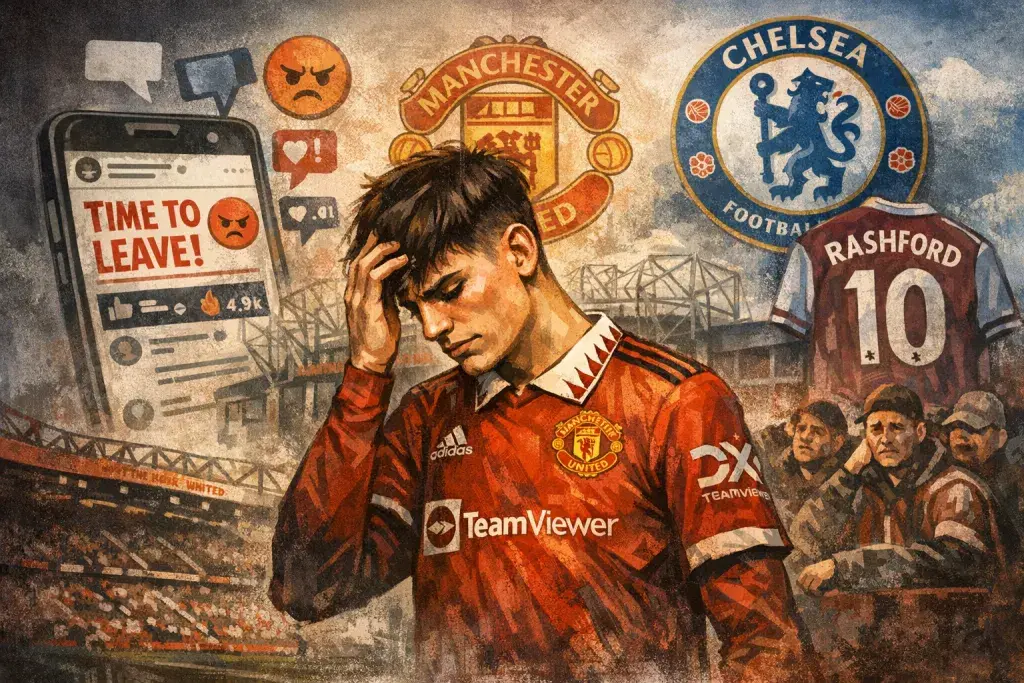
Alejandro Garnacho has publicly acknowledged, for the first time, that his behaviour during the final months of his time at Manchester United contributed directly to his departure from the club. Speaking in an interview with the Premier League, the 21-year-old Argentine winger offered a candid assessment of a period he described as painful — one that ended with a £40 million move to Chelsea last summer and left a complicated legacy behind it.
A Young Man's Reckoning With His Own Choices
What makes Garnacho's admission notable is its rarity. Public figures in professional football rarely accept personal responsibility when exits turn acrimonious. The more common response is deflection — criticism of management, coded complaints about opportunity, or silence. Garnacho chose a different path, acknowledging directly that his mindset became a problem.
"In my mind, maybe it is also on me, I started to do some bad things," he said. "But yes, it was just this moment in life and sometimes you have to make decisions."
The context matters. Garnacho was, by most accounts, a prodigiously talented young man who rose rapidly through United's academy system after being brought over from Spain in his early teens. That acceleration — from youth prospect to first-team regular by his late teens — is precisely the kind of trajectory that can distort a young person's sense of entitlement. When former manager Ruben Amorim reduced his playing time, the reaction was not quiet adaptation. Instead, Garnacho turned to social media to voice his frustrations, a move that accelerated the breakdown in his relationship with the club's leadership and ultimately made his sale inevitable.
His family's involvement added fuel. Reports of his brother posting inflammatory content online, combined with the player himself photographed wearing the Aston Villa jersey of Marcus Rashford — another figure who had fallen out of favour at United — were read by many as deliberate provocations. Whether or not that was the intent, the optics were corrosive to any remaining possibility of reconciliation.
The Psychology of Early Success and Its Consequences
Garnacho's trajectory illustrates a pattern that recurs in high-performance environments well beyond football. Young individuals who achieve significant success early — before their identity has fully stabilised — often struggle when conditions shift. The sense of being indispensable, built over years of exceptional output, collides sharply with the experience of reduced visibility or authority. For many, the instinct is not to reflect but to resist.
Social media has made this dynamic considerably more volatile. Platforms that reward emotional expression and immediate reaction give young people a mechanism to broadcast grievances in real time, often before the consequences of doing so have been considered. In a professional context, where institutional relationships are delicate and reputational capital is accumulated slowly, this can be ruinous. Garnacho's case is an illustration of exactly that dynamic playing out at speed.
His reflection now — that he was only 20, that sitting on the bench was "not such a bad thing," and that his insistence on playing every game was a cognitive distortion of that moment — suggests some genuine self-awareness has emerged on the other side of a difficult experience. Whether that awareness arrived in time to salvage his standing at his new club is a separate question.
Chelsea and the Weight of Unmet Expectations
Life at Stamford Bridge has not delivered the reset Garnacho required. A single Premier League goal to his name this season tells a stark story of a young man still searching for footing. The club's recent elimination from the Champions League and a difficult run of domestic results have done little to create the stable environment in which a player of his temperament might rediscover form. A change of management — Liam Rosenior replacing Enzo Maresca in January — added further uncertainty to a situation that demanded continuity.
The £40 million fee attached to his arrival at Chelsea now sits uneasily against his output. He is contracted until 2032, which means the club has a long-term obligation to a player who has yet to demonstrate that his United form was anything more than a high point that coincided with favourable conditions. Reports suggesting that River Plate, under Eduardo Coudet, has made direct contact to explore a year-long loan arrangement indicate that a temporary exit from England is being considered as a possible route back to confidence and relevance.
A loan to South America would represent a significant shift in Garnacho's circumstances — from the intensity of the Premier League to an environment that might, paradoxically, restore the sense of centrality he found destructive when he lost it. The risk is that it reads as retreat. The potential benefit is that it offers an environment lower in scrutiny and higher in playing time, which for a 21-year-old still forming his professional identity could carry genuine value.
A Difficult Exit, Honestly Assessed
Garnacho was clear that leaving United was painful, not because of resentment toward the institution, but because of how much it had given him. "They gave me the confidence from the start, from Spain, to bring me to the academy, then they bring me to the first team," he said. "Amazing love from everyone, from the fans, the stadium, everything was really good."
That affection, expressed without bitterness, suggests the reflective capacity that was notably absent during the final months of his time there. The version of Garnacho who turned to social media during difficult spells and who allowed his frustration to become visible in ways that undermined his own position seems, at least in his telling, to be a version he has examined and moved beyond. Whether his actions at Chelsea will bear that out remains to be seen. What is clear is that at 21, with a long contract, an honest public reckoning, and an obvious talent that has not disappeared, the story is not close to finished.